




足関節捻挫について
2026年01月17日
病態
最も多いスポーツ外傷で、全外傷の25.4%(骨折なしのケース)を占めます。
救急病院に行く頻度は、人口10,000人あたり70人です。足首を内反+底屈させて外側を受傷するケースが全体の85%を占め、そのうち80%は前距腓靭帯、20%は踵腓靭帯の損傷です。
足首の捻挫は再発率が高く、合併症が早期のスポーツ復帰を妨げます。また、足首捻挫の後遺症として慢性足関節不安定症(Chronic Ankle Instability; CAI)が長期的なパフォーマンス低下の原因となり、約40%の患者が足関節不安定症を発症します。
- 受傷時に損傷する組織
- 前距腓靭帯(Anteriortalofibular ligament ; ATFL)
- 後距腓靭帯(Posteriortalofibular ligament ; PTFL)
- 踵腓靭帯(Calcaneofibular ligament ; CFL)
- 前脛腓靭帯(Anterior inferior tibiofibular ligament:AITFL)
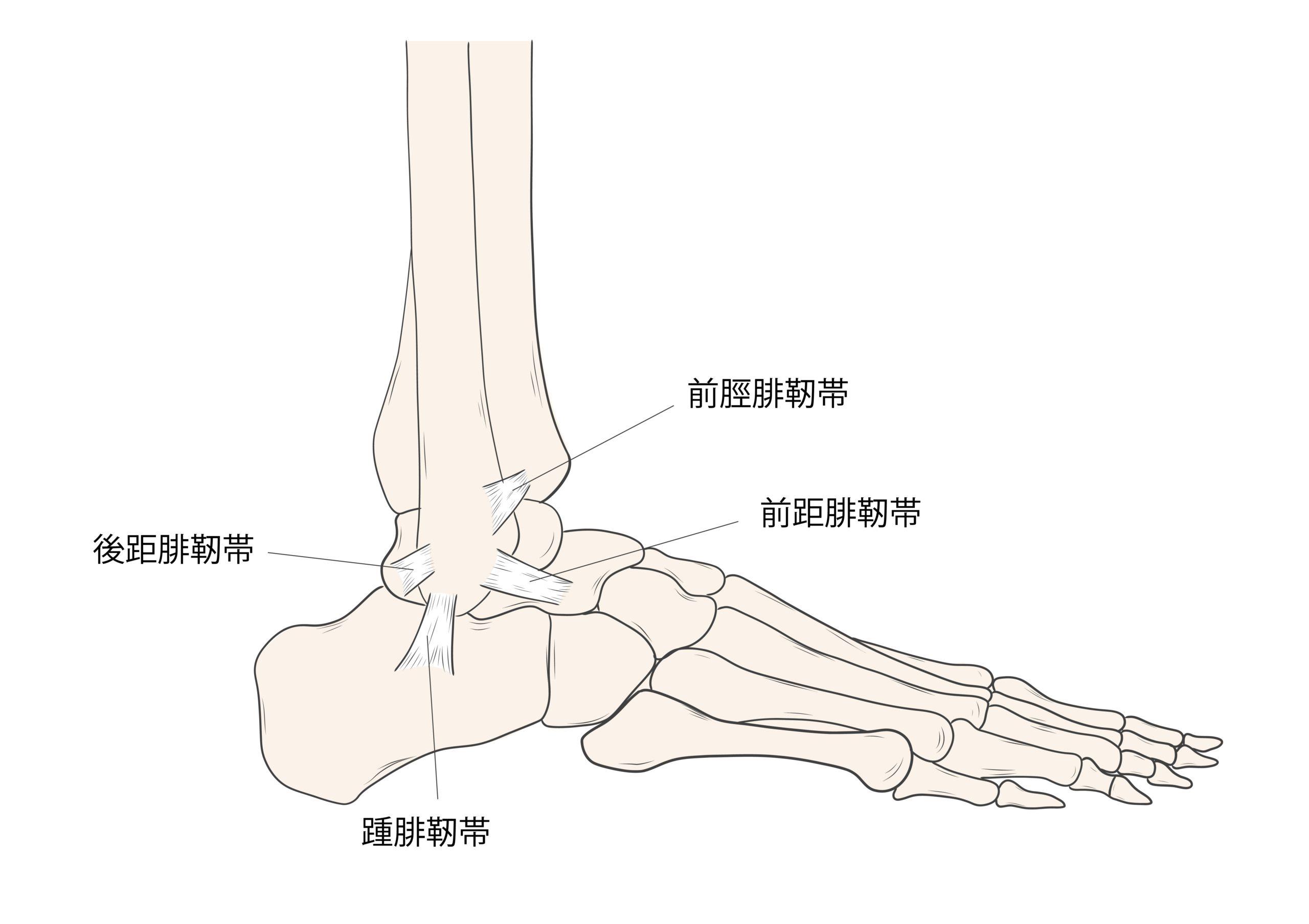
- 長・短腓骨筋腱,二分靭帯などの足関節外側に位置する組織が代表的である。
- 再発率は2週間から8年以内に3-34%と報告がある。
- 患者の約50%は医療機関を受診しないと推測されており、実際の受傷率はデータで報告されているものよりも、さらに高いと考えられる。
発生機序
- 足関節底屈位もしくは背屈位での内がえし(内反)および内旋強制によって生じる。
- ジャンプ着地時(特に相手の足の上に着地時)足関節の急な内反、内旋を伴う急速な切り返しや、接触や転倒により生じる。
- 急性期:受傷直後の炎症が治るまでの期間(受傷後72時間)
- 腫れ、内出血
- 前距腓靭帯や踵腓靭帯の圧痛
- 足関節内反時に痛み
- 足関節の可動域制限
- 荷重時の足関節不安定性および恐怖感
- 回復期:急性期の炎症反応が落ち着いた状態
重症度分類
American Medical Associationに基づく分類
Grade 1
- 小範囲の線維の損傷で不安定性を認めないもの
- 最小限の損傷。触診時に痛みが出るが、不安定性はみられない。
Grade 2
- 軽・中等度の不安定性を認めるが完全断裂には至らないもの
- エンドフィールはあるが緩みあり
Grade 3
- 靭帯の完全断裂
- 強い痛みと機能的障害がみられる
リスク因子
- サッカーにおいて足関節外傷の発生率は 11 ~ 31%である。そのうち足関節捻挫の発生頻度は 60 ~ 70%と他の競技と比べて高いと報告されている。
- 足関節不安定症(Foot Ankle Instability) の原因は、靭帯損傷などの静的安定機構の破綻ではなく、靭帯や関節包に分布する神経終末であるメカノレセプターが損傷されることにより固有感覚が障害を受け、神経―筋のコントロール不全が生じることが原因といわれている。
- 14-24歳の男性、30歳以上の女性に多い
- 女性の方が慢性不安定になりやすい(リスク比1.25)
- 49.3%はスポーツ活動中に起きる
- バスケットボール (41.1%)、アメリカンフットボール (9.3%)、サッカー (7.9%)
- 足関節捻挫の既往:リスク比2.14
- 足関節背屈制限
- 固有感覚の低下
- 受傷後バランストレーニングをしていない
エビデンスでは以上のようにありますが、当院では経験上Grade 2から靭帯の瘢痕化を目的としてギブス固定を強く勧めます。
なぜならば中途半端な固定だと靭帯が伸びたまま瘢痕化して関節が緩くなってしまいます。こうなると手術する以外一生治りません。骨が折れていないからといって、甘くみない方が良いです。
当院では徒手検査と、エコー検査で患部の状態を確認していきます。必要であれば専門医に対診もしていきます。
安心してご相談ください!
参考文献
- 小林匠. “足関節捻挫の病態と治療.” 日本アスレティックトレーニング学会誌 3.2 (2018): 117-126.
- Malliaropoulos, Nikolaos, et al. “Acute lateral ankle sprains in track and field athletes: an expanded classification.” Foot and ankle clinics 11.3 (2006): 497-507.
- Delahunt, Eamonn, et al. “Clinical assessment of acute lateral ankle sprain injuries (ROAST): 2019 consensus statement and recommendations of the International Ankle Consortium.” British journal of sports medicine 52.20 (2018): 1304-1310.
- van Rijn, Rogier M., et al. “What is the clinical course of acute ankle sprains? A systematic literature review.” The American journal of medicine 121.4 (2008): 324-331.
- Woods, Carol, et al. “The Football Association Medical Research Programme: an audit of injuries in professional football: an analysis of ankle sprains.” British journal of sports medicine 37.3 (2003): 233-238.
- Vuurberg, Gwendolyn, et al. “Diagnosis, treatment and prevention of ankle sprains: update of an evidence-based clinical guideline.” British journal of sports medicine 52.15 (2018): 956-956.
- Karlsson, J., and L. Peterson. “Evaluation of ankle joint function: the use of a scoring scale.” The foot 1.1 (1991): 15-19.
- Esterson, Perry S. “Measurement of ankle joint swelling using a figure of 8.” Journal of Orthopaedic & Sports Physical Therapy 1.1 (1979): 51-52.
- Croy, Theodore, et al. “Anterior talocrural joint laxity: diagnostic accuracy of the anterior drawer test of the ankle.” journal of orthopaedic & sports physical therapy 43.12 (2013): 911-919.
- Ko, Jupil, Adam B. Rosen, and Cathleen N. Brown. “Functional performance tests identify lateral ankle sprain risk: a prospective pilot study in adolescent soccer players.” Scandinavian journal of medicine & science in sports 28.12 (2018): 2611-2616.
- Gribble, Phillip A., et al. “Prediction of lateral ankle sprains in football players based on clinical tests and body mass index.” The American journal of sports medicine 44.2 (2016): 460-467.
- Konradsen, Lars, Susanne Olesen, and Henrik M. Hansen. “Ankle sensorimotor control and eversion strength after acute ankle inversion injuries.” The American Journal of Sports Medicine 26.1 (1998): 72-77.
- Aiken, Alice B., et al. “Short-term natural recovery of ankle sprains following discharge from emergency departments.” journal of orthopaedic & sports physical therapy 38.9 (2008): 566-571.
- McGuine, Timothy A., and James S. Keene. “The effect of a balance training program on the risk of ankle sprains in high school athletes.” The American journal of sports medicine 34.7 (2006): 1103-1111.
- Shell, Ian G., et al. “Decision rules for the use of radiography in acute ankle injuries: refinement and prospective validation.” Jama 269.9 (1993): 1127-1132.
- Polzer, Hans, et al. “Diagnosis and treatment of acute ankle injuries: development of an evidence-based algorithm.” Orthopedic reviews 4.1 (2012).
- 豊岡毅, et al. “足関節捻挫に対する画像検査の活用.” 理学療法学 41.8 (2014): 600-606.
- Choi, Ji Hye, et al. “Consistency and reliability of ankle stress radiography in patients with chronic lateral ankle instability.” Orthopaedic Journal of Sports Medicine 9.5 (2021): 23259671211004099.
- Vuurberg, Gwendolyn, et al. “Diagnosis, treatment and prevention of ankle sprains: update of an evidence-based clinical guideline.” British journal of sports medicine 52.15 (2018): 956-956.
- Green, Toni, et al. “A randomized controlled trial of a passive accessory joint mobilization on acute ankle inversion sprains.” Physical therapy 81.4 (2001): 984-994.
- Cain, M. Spencer, et al. “Four-week ankle-rehabilitation programs in adolescent athletes with chronic ankle instability.” Journal of athletic training 55.8 (2020): 801-810.
- Kaminski, T. W., et al. “Effect of strength and proprioception training on eversion to inversion strength ratios in subjects with unilateral functional ankle instability.” British journal of sports medicine 37.5 (2003): 410-415.
- Mattacola, Carl G., and Maureen K. Dwyer. “Rehabilitation of the ankle after acute sprain or chronic instability.” Journal of athletic training 37.4 (2002): 413.
- Labovitz, J. M., et al. “Magnetic resonance imaging of ankle ligament injuries correlated with time.” Journal of the American Podiatric Medical Association 88.8 (1998): 387-393.
- Hubbard, Tricia J., and Charlie A. Hicks-Little. “Ankle ligament healing after an acute ankle sprain: an evidence-based approach.” Journal of athletic training 43.5 (2008): 523-529.